
Description
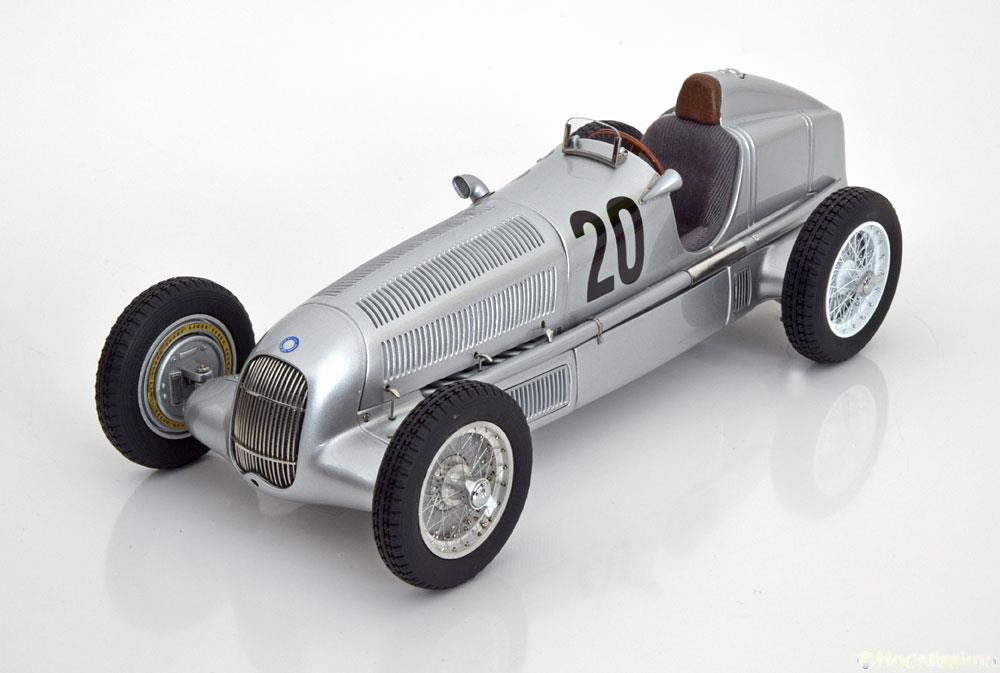
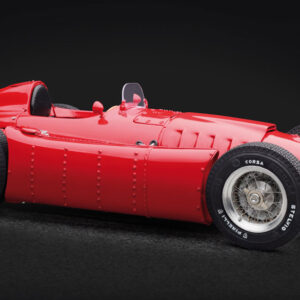
CMC Mercedes-Benz W25, Eifelrennen # 20, Manfred v. Brauchitsch, 1934
- Hand-assembled metal precision model made from more than 890 parts
- Authentic and true-to-scale moulded bodywork
- 8-cylinder in-line engine with compressor and add-on units, as well as pipework / cabling
- Removable bonnet with perforated cooling slots and spring-loaded locking hooks
- Handcrafted radiator grille made of stainless steel with flat moulded crossbars and soldered vertical bars, as well as a metal radiator grille behind the grille
- Perfect spoke wheels with aluminium rims and stainless steel wire spokes drawn in by hand. All spokes additionally fitted with nipples
- Unscrewable, double-leaf wheel centre locks
- Stainless steel dashboard with marbled surface and hand-inset instruments
- Cockpit seat in textile design and headrest with genuine leather cover
- Brilliant paintwork with start numbers applied using an elaborate pad printing process
Description of the original vehicle:
After several years of absence of Daimler-Benz from Grand Prix racing, 1934 marked the return of the brand with the three-pointed star to the racetracks of those days. With the creation of a new Grand Prix racing formula limiting the vehicle weight to 750 kg, Daimler-Benz created a new GP racing car with the factory designation W25. It was a sleek and aerodynamically excellently shaped vehicle with a long overhanging headrest and an exhaust manifold running along the side of the vehicle.
The Eifel race held on the famous Nürburgring on 3 June 1934 was to be the first major baptism of fire for the race-ready Mercedes monoposti. Because Mercedes regular driver Rudolf Caracciola was still handicapped by an injury, the young daredevil Manfred von Brauchitsch was entered for the race.
However, there were problems with the vehicle approval before the race. The Mercedes exceeded the required 750 kg limit by 1 kg. What followed went down in racing history. The white paint was scraped off at night, resulting in a weight reduction to 750 kg. What remained were shiny, silvery aluminium bodies that would henceforth become known as the „Silver Arrows“.
Manfred von Brauchitsch with start number 20 crossed the finish line first after an exciting race. Hans Stuck followed in second place in an Auto Union and Louis Chiron came third in an Alfa Romeo.
The Eifel race held on the famous Nürburgring on 3 June 1934 was to be the first major baptism of fire for the race-ready Mercedes monoposti. Because Mercedes regular driver Rudolf Caracciola was still handicapped by an injury, the young daredevil Manfred von Brauchitsch was entered for the race.
However, there were problems with the vehicle approval before the race. The Mercedes exceeded the required 750 kg limit by 1 kg. What followed went down in racing history. The white paint was scraped off at night, resulting in a weight reduction to 750 kg. What remained were shiny, silvery aluminium bodies that would henceforth become known as the „Silver Arrows“.
Manfred von Brauchitsch with start number 20 crossed the finish line first after an exciting race. Hans Stuck followed in second place in an Auto Union and Louis Chiron came third in an Alfa Romeo.
Item number: M-103
 German
  English
  Italian
  French
  Spanish
  Arabic
  Japanese
Reviews
There are no reviews yet.