
Description
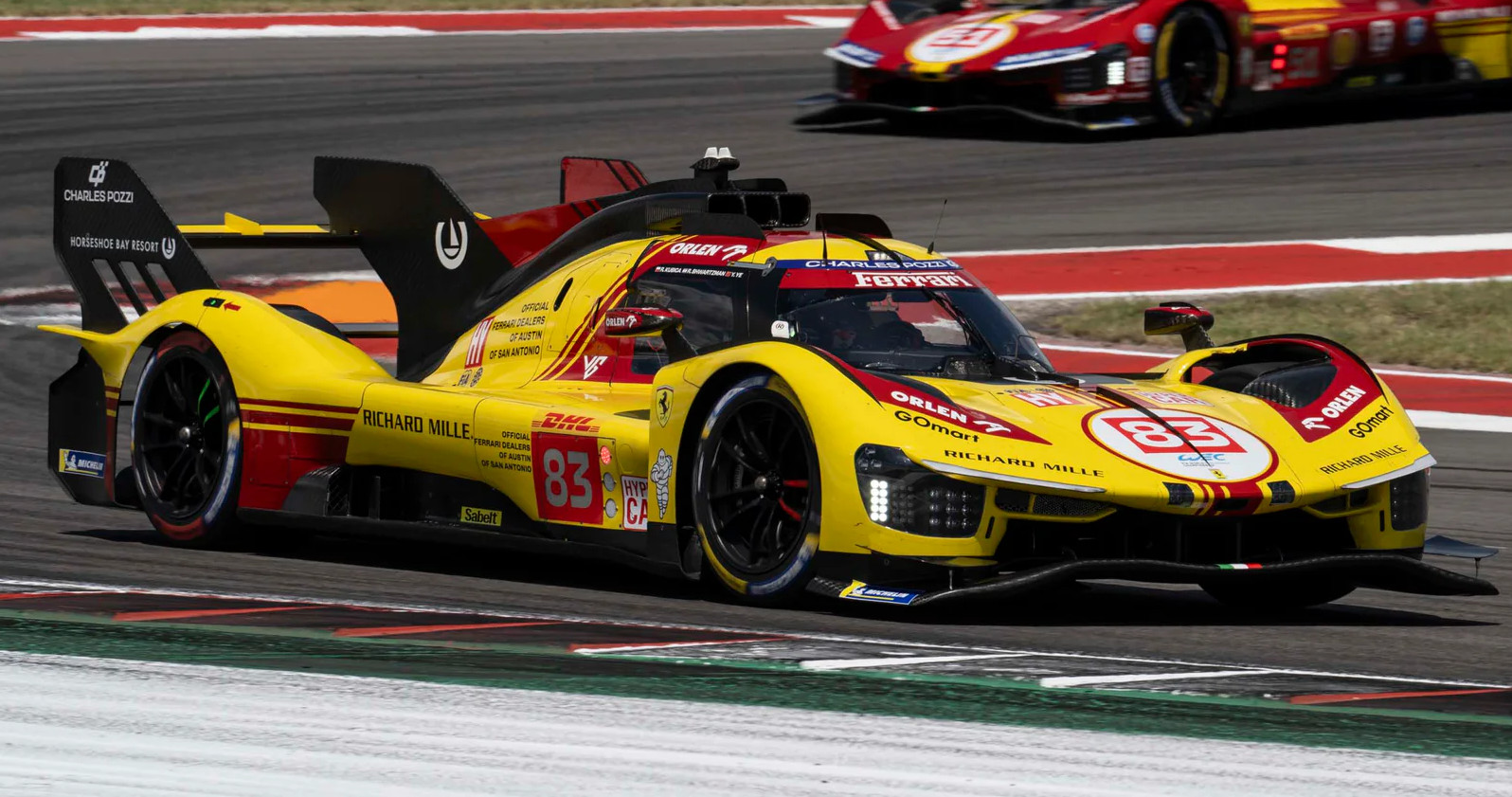
Amalgam Ferrari 499P - The Lone Star Le Mans 2024 1:8 Limited to only 499 pieces
- Based on the #83 AF Corse hypercar that Robert Kubica, Robert Shwartzman and Yifei Ye drove to victory in the Lone Star Le Mans at the Circuit of the Americas on 1 September 2024
- Each model was built and assembled by hand by a small team of craftsmen
- Complete with opening doors and motor cover
- 1:8 scale model, over 63 cm/25 inches long
- Over 4000 hours spent developing the model
- Over 400 hours to build each model
- Made from the highest quality materials
- Thousands of precisely engineered parts: Castings, photo etchings and CNC machined metal components
- Built according to original CAD designs based on scans of a real car
- Original paint codes and material specifications from Ferrari
The 499P, the car that brought Scuderia Ferrari back to the pinnacle of sports car racing, was Ferrari's first foray into the newly created hypercar class of the FIA World Endurance Championship, where it won the fabled 24 Hours of Le Mans two years in a row. Introduced for the 2023 season, the 499P marked Ferrari's return to the elite class of endurance racing for the first time in 50 years.
Winner DNA
While the car is undeniably designed to take Ferrari into the future, the name 499P is a reminder of the Maranello-based manufacturer's history, a naming system that harks back to its previous Le Mans entries; the 499 refers to the displacement of its engine, while the P stands for prototype. The hypercar also wears a livery in the same colours as the 1973 312P as a nod to Ferrari's last involvement in endurance racing half a century ago and a reminder of a long association with competition that is embedded in the DNA of the Ferrari brand. The starting numbers of the cars were chosen for similar reasons - the number 50 represents the long period that Ferrari did not compete in the top class at Le Mans, and the number 51 adorned a winning Ferrari GT four times.
New hybrid power and innovative technology
In developing the 499P, Ferrari drew on its vast resources of technical, professional and human excellence that epitomise the brand from Maranello and entrusted the management of Attività Sportive GT under the direction of Antonello Coletta and the technical supervision of Ferdinando Cannizzo, head of the sports and GT racing car design and development department. Although the design is limited by aerodynamic and space-saving requirements, it remains unmistakably a Ferrari. This is not surprising for a car designed and manufactured exclusively in Maranello and refined with the support of the Ferrari Styling Centre under the direction of Flavio Manzoni. The car's technical and aerodynamic characteristics were enhanced by simple, curved shapes: an explicit expression of Ferrari's DNA. The balance between taut lines and flowing surfaces, expressed in a futuristic, pure and iconic language, defines a clear yet essential architecture. The moulded body promotes aerodynamic flows through the sidepods and cools the radiators hidden underneath. The wheel arches are characterised by large louvres and, together with the headlight clusters, give the nose a certain character and expressiveness, with subtle references to the styling features first introduced on the Ferrari Daytona SP3. The rear is the ultimate expression of the fusion of technology, aerodynamics and design; a subtle carbon fibre skin covers the various features, leaving the wheels and suspension fully visible. The rear is characterised by a double horizontal wing; the main wing and upper flaps have been carefully designed to provide the necessary downforce and maximise performance. The lower wing also features a „light bar“ that adds a decisive yet minimalist touch to the rear design.
The 499P is based on a completely new monocoque chassis made of carbon fibre and features solutions that represent the state of the art in motorsport technology. The suspension with double wishbones and push rods offers excellent damping stiffness, the benefits of which are noticeable both on straight stretches and in bends. The electronic systems have been developed and refined from the experience gained in GT racing. The hypercar has a hybrid drive system that combines a mid-rear engine with an electric motor driving the front axle and is coupled to a sequential seven-speed gearbox. The 2.9-litre twin-turbo V6 used is the same engine used in the 296 GT3 and its road-going cousins, with a maximum power output of 500 kW (680 hp). In addition, there is an energy recovery system (ERS) connected to the front axle and fed by a brake-by-wire system. The ERS delivers 200 kW, and the battery that powers it utilises know-how from Ferrari's extensive F1 experience. Among the special features of the 499P's V6 is the fact that the engine is load-bearing and therefore fulfils a valuable structural function compared to the versions fitted to GT race cars, where the engine is mounted on the rear under-chassis of the car.
Competition history
The Ferrari 499P will be supported on the track by technicians and engineers from Maranello in collaboration with racing partner AF Corse, continuing the long-standing, successful partnership that began in 2006. For the 2023 FIA World Endurance Championship (WEC) season, Ferrari GT racers Antonio Fuoco, Miguel Molina and Nicklas Nielsen took control of the No. 51 car, while two-time LMGTE Pro World Champions Alessandro Pier Guidi and James Calado were joined by Ferrari's Formula 1 stand-in driver Antonio Giovinazzi at the wheel of the sister No. 51 car.
The highly anticipated debut of the 499P took place at the 1000 Miles of Sebring, with the No. 50 car setting an early benchmark by securing pole position. Despite leading from the start line, the Ferrari was overtaken by the two Toyota Gazoo Racing cars and eventually finished third, earning a podium finish in Ferrari's return to prototype endurance racing. Ultimately, the 499P was often overtaken by the Toyotas, who secured the title for the fifth year in a row, but Ferrari remained ahead of the other manufacturers. Having only failed to finish on the podium once all season, Ferrari AF Corse was the only real challenger to the Japanese team, and both cars carried the championship battle through to the season finale in Bahrain. The highlight of the season, however, was the famous 24 Hours of Le Mans: the #50 qualified for the Hyperpole once again, but it was the #51 car with Pier Guidi, Calado and Giovinazzi that secured a victorious return to the Circuit de la Sarthe after an intense and dramatic contest.
Ferrari AF Corse presented a third 499P for the 2024 season: the No. 83, driven by the official Ferrari drivers Yifei Ye and Robert Shwartzman as well as the FIA WEC LMP2 champion and Formula 1 race winner Robert Kubica. The 499P was also set to shine at Le Mans: This time it was Fuoco, Molina and Nielsen in the No. 50 who took the overall victory, marking Ferrari's eleventh success in the race. In an increasingly competitive championship, which now features nine different manufacturers, the team remains in the thick of the battle for the title between Porsche and Toyota.
Lone Star Le Mans, 1 September 2024
This model of the Ferrari 499P is a perfect 1:8 scale replica of the #83 AF Corse hypercar that Robert Kubica, Robert Shwartzman and Yifei Ye drove to victory at the Lone Star Le Mans at the Circuit of the Americas on 1 September 2024. Kubica qualified the #83 second on the grid, only behind the #51 Ferrari AF Corse of Antonio Giovinazzi, giving the Italian marque a great chance of victory if it could last the entire six-hour race in the scorching Texas heat. A strong start from both Ferraris kept their positions from the beginning, while the #50 Ferrari of Miguel Molina quickly moved up from fifth to third, securing a Ferrari one-two-three after just half an hour. But just five minutes later, Giovinazzi allowed Kubica to pass, giving the No. 83 the lead as the cars went off strategy. Kubica began a remarkable triple stint. Misfortune struck the No. 51 when it skidded at turn 12 while trying to lap the No. 94 Peugeot. She eventually retired before the two-hour mark after having problems restarting and returning to the pits.
After completing his triple stint, Kubica immediately handed over to Ye, who skilfully defended against the fast-approaching Nick De Vries in the No. 7 Toyota, who had made phenomenal progress from ninth on the grid. De Vries eventually pitted and undercut the No. 83, handing the Toyota over to Kamui Kobayashi for the final stages of the race. Ye completed his two stints before handing control of the No. 83 to Shwartzman, who regained the lead through the driver change stops. The next round of pit stops saw the Toyota undercut the Ferrari again; however, drama ensued when Kobayashi was handed a drive-through penalty for failing to slow down sufficiently under yellow flags while the stalled Peugeot 9X8 was recovered by Paul di Resta. This penalty allowed Shwartzman to regain the lead, which he fiercely defended against Kobayashi to secure victory by just 1.78 seconds. The No. 50 Ferrari completed the podium a further 25 seconds behind.
The No. 83's success ensured a sixth different winner in six highly competitive WEC rounds, and the margin was the second closest between competing manufacturers in WEC history. Most remarkably, the yellow AF Corse No. 83 was the first private Ferrari in over 50 years to win an internationally recognised sportscar race, on a day when the Italian marque was celebrating victory at its home Formula 1 Grand Prix in Monza.
The 1:8 scale Ferrari 499P is limited to 499 units per livery.
Item number: Superfast12
 German
  English
  Italian
  French
  Spanish
  Arabic
  Japanese
Reviews
There are no reviews yet.