
Description
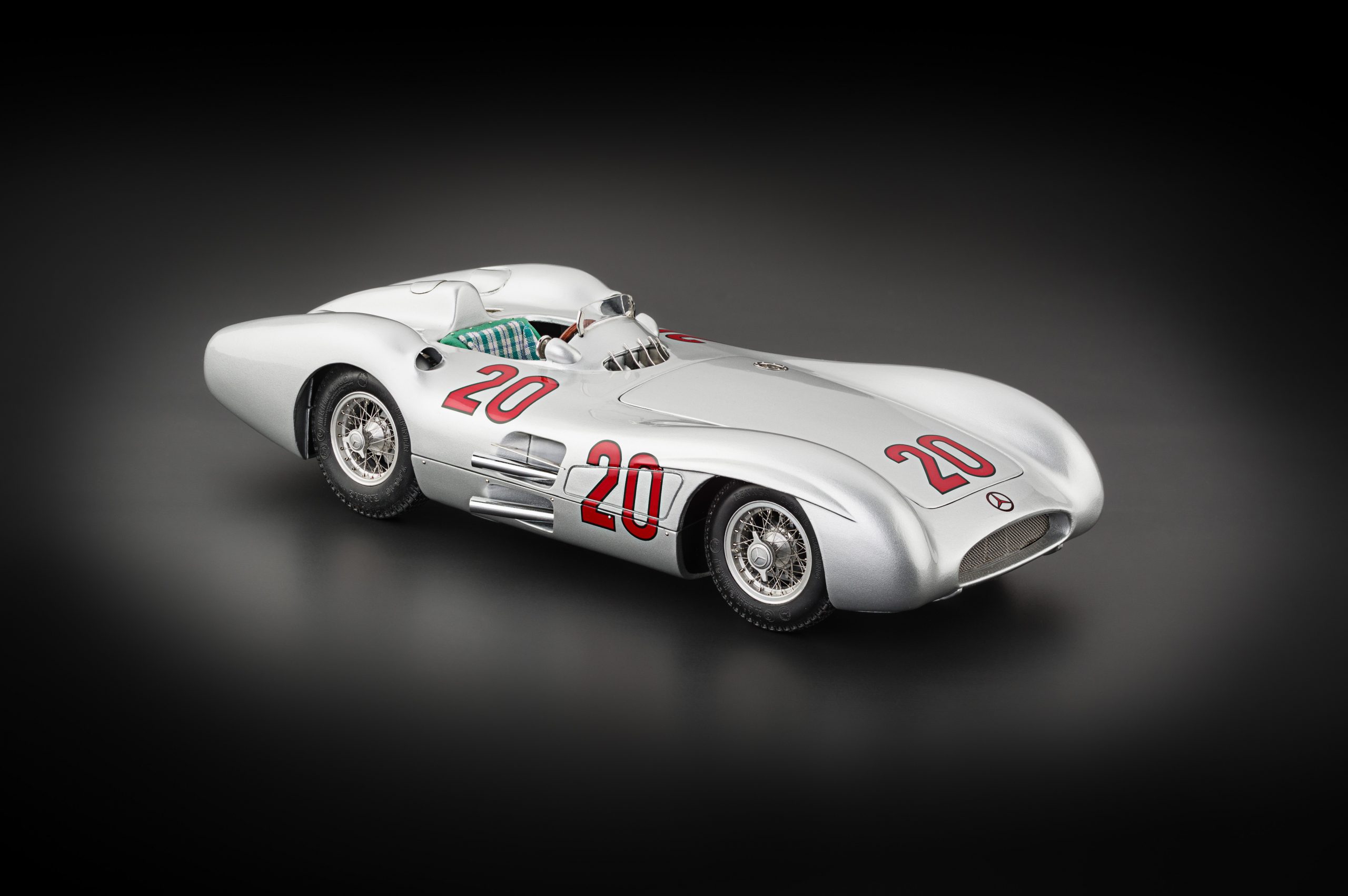
CMC Mercedes-Benz W196R Streamline, 1954, GP France #20 Karl Kling,
July 2014 marks the 60th anniversary of Mercedes-Benz's return to Grand Prix racing after the war.
The occasion was the French Grand Prix on 4 July 1954 in Reims, to which Mercedes sent three Siberpfeile W196Rs with the new sensational streamlined bodywork.
Differences between M-044 (Standard Version old) and M-128 A/B/C (Limitations GP - France, 1954 )
- Air inlet in front of windscreen for cockpit ventilation with 5 inserted metal louvres
- Rear-view mirror consoles with shape change
- Modified rear air vents with stainless steel air baffle and double cover bars
- Modified, i.e. shortened tank filler flap in the headrest
- Improved wheels with nippled spokes
- Different start numbers 18; 20; 22
- Shape-modified bonnet with flat surface and omission of the air intake opening with mesh grille (for Start - No. 22 deviating additionally small bulge in the right bonnet area)
- Reshaped body cut-out, suitable for the modified bonnet
- Modified air intake tract (modified engine intake manifold with modified air inlet)
- Modified cooling water expansion tank with separate water filler pipe
- Round access opening in the bonnet for the oil filler neck of the oil tank (left-hand side of the vehicle)
- Illustration of an oil filler neck for the oil reservoir
- Recessed radiator grille (protective grille) immovable
- Elimination of the movable radiator grille with associated actuating linkage in the cockpit
- Closed right-hand motor maintenance flap
- Changed arrangement of the exhaust tailpipes. Separate pipe routing through the two side body openings with chrome trim bar in the upper opening (right-hand side)
- Left-hand side body openings each with a chrome trim bar
- Reshaped air vents on the rear mudguards
- Printed red Mercedes star above the radiator grille (front area)
- Different colours of the driver's seat fabric covers and the leather-covered seat surrounds ( brown-red no.18; green no.20; blue no.22 )
- Elimination of the small headrest
- 4-spoke steering wheel with back-painted spokes in the base colour of the seat cover
- Additional oil temperature indicator below the dashboard
Description of the original vehicle:
Mercedes took its time and prepared thoroughly for its return to Grand Prix racing. The elegant streamlined bodywork of the Mercedes racing cars is an absolute novelty and turns the traditional racing car design known to date completely on its head. The competitors are amazed and speechless, but for the almost 300,000 spectators at the race track, the appearance is a real sensation.
Mercedes lined up with three W196R cars and the drivers Juan Manuel Fangio, Karl Kling and the young Hans Herrmann. The premiere race at the French Grand Prix on 4 July 1954 was a good choice, as the fast track in Reims with its long straights suited the streamlined cars very well.
Fangio (start no. 18) and Kling (start no. 20) start from the front row alongside Ascari's Maserati 250F. After Ascari's retirement on the first lap, the two Ferraris of Gonzalez and Hawthorn are behind the leading Mercedes of Fangio and Kling. Hans Herrmann with the star number 22 starts the race from the third row in 5th place. After seven laps he passes Hawthorn and on the eleventh lap he overtakes Gonzalez. Now all three W196Rs were in the lead until Hans Herrmann's engine suddenly went on strike on lap 17 and he had to park his Silver Arrow with engine damage.
At the end of the race, there was a dramatic battle for victory between Fangio and Kling, which J.M. Fangio won by a wafer-thin margin of just one metre.
After a fifteen-year absence, the Mercedes thus brought home a highly acclaimed one-two victory in their first appearance on the international motorsport stage.
Mercedes lined up with three W196R cars and the drivers Juan Manuel Fangio, Karl Kling and the young Hans Herrmann. The premiere race at the French Grand Prix on 4 July 1954 was a good choice, as the fast track in Reims with its long straights suited the streamlined cars very well.
Fangio (start no. 18) and Kling (start no. 20) start from the front row alongside Ascari's Maserati 250F. After Ascari's retirement on the first lap, the two Ferraris of Gonzalez and Hawthorn are behind the leading Mercedes of Fangio and Kling. Hans Herrmann with the star number 22 starts the race from the third row in 5th place. After seven laps he passes Hawthorn and on the eleventh lap he overtakes Gonzalez. Now all three W196Rs were in the lead until Hans Herrmann's engine suddenly went on strike on lap 17 and he had to park his Silver Arrow with engine damage.
At the end of the race, there was a dramatic battle for victory between Fangio and Kling, which J.M. Fangio won by a wafer-thin margin of just one metre.
After a fifteen-year absence, the Mercedes thus brought home a highly acclaimed one-two victory in their first appearance on the international motorsport stage.
Item Number: M-128B
2-new
 German
  English
  Italian
  French
  Spanish
  Arabic
  Japanese
Reviews
There are no reviews yet.